 Autumn sunshine still warmed the grounds of the
October 23, 2026
Autumn sunshine still warmed the grounds of the

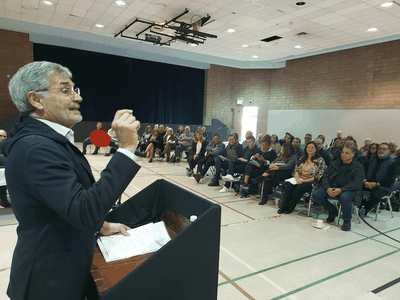
Hellenic Community Centre of the South Shore in Saint-Hubert on the afternoon of Sunday, October 18, as members filed into the gymnasium, embraced old friends and took their seats in long rows of blue chairs beneath twin projection screens. An opening recitation of the Lord’s Prayer, spoken in unison in Greek, set the tone for a gathering devoted to the stewardship of a 120-year-old institution. Over the three hours that followed, the annual general assembly of the Hellenic Community of Greater Montreal heard evidence of a dramatic financial recovery, ambitious plans for a $10-million endowment fund, frank talk about aging buildings and school enrolment, and repeated reminders that the Greek language remains the living heart of communal life in Montreal.
A live electronic dashboard projected above the floor confirmed that 122 members had been admitted and that the quorum of 100 had been comfortably reached, with 73 attendees from the South Shore, 31 from Montreal, 17 from Laval and one from the West Island. Members elected Mr. Nick Pagonis to chair the proceedings and Mrs. Eleni Panagiotarakou as secretary of the assembly. When the minutes of the June 28 special general assembly were read aloud entirely in Greek by Mrs Panagiotarakou, who had offered to proceed in English, the chair paused the agenda to mark the moment. “We are the only community in the Greek diaspora whose principal language at our official gatherings is still Greek,” he told the hall. “Congratulations to the new generation that keeps our roots strong.”
The central business of the day was financial, and the news was the best the community has received in years. John Charalambopoulos, a partner at Richter, the community’s external auditing firm, walked members through audited statements for the fiscal year ended June 30, 2026. Revenues reached $18.8 million, up close to $1 million from the previous year, lifted by school fees, church income and a combined $1.8 million from dances, festivals and fundraising campaigns. With expenses held essentially flat at $19.3 million, the accounting deficit narrowed to $446,264 from $1.5 million a year earlier, and once non-cash amortization is set aside, the year produced an operating surplus of $644,626, compared with a shortfall of roughly $512,000 the year before. Members voted unanimously to approve the statements and to reappoint Richter for the fiscal year ending June 30, 2027.
President Basile Angelopoulos, delivering his first annual report since his team took office, described a year of financial discipline in which an operating deficit of about $500,000 was converted into that surplus, an improvement he placed at more than $1.1 million in 12 months. He credited the finance committee led by Treasurer Eleni Chilakos, saying that today no community dollar is spent without its approval, and he pointed to a transparency policy that has placed every community contract on the organization’s website for any member to read. “The element of trust is returning to our community,” he said, citing calmer tones, fuller halls and festivals in Laval, Montreal and the South Shore that drew more than 14,000 people over a single three-day weekend, with young people making up an estimated 70 to 80 per cent of the crowds.
That restored credibility, Mr. Angelopoulos argued, now makes possible the project he considers decisive for the community’s future, an endowment fund managed professionally and independently of any administration, present or future. Commitments of $1.3 million have been secured and $550,000 already sits in the bank, he reported, with a first round of donor meetings beginning the Wednesday after the assembly. “With the experience of this first year, I can tell you that if we do not reach $10 million, it will be a failure,” he said, noting that a conservative five per cent return would deliver half a million dollars to churches, schools, cultural and social programs every year in perpetuity.
The president reserved his warmest words for the volunteers he affectionately calls his “thieves,” asking the roughly 50 board and regional council members present to stand. “These are the people who “steal” hours from their work, from their families and from their personal interests for the benefit of the community and of Hellenism,” he said. Volunteer tradespeople of Greek descent have renovated the community’s eight derelict seniors’ apartments, which now rent at market rates, repaved the entrance of the Wilderton offices on extended payment terms, and replaced a dangerous staircase in Laval. New leases and gifts added more, including about $70,000 a year from an Armenian secondary school renting the upper floor of the Hood building and a $250,000 donation for an elevator at Holy Cross church in Laval. Fundraising told a similar story. A rained-out golf tournament still cleared $100,000, the lottery netted $233,000, and the schools radiothon raised $450,000 against a $200,000 target, financing washroom renovations and new desks across five campuses. The next radiothon, set for December 5, carries a $1-million goal.
The afternoon was candid about what remains undone. The gymnasium roof above the assembly leaks so badly that a contractor warned it could fail, the lowest repair bid stands at $300,000, and 22 workers were restoring the Montreal community centre roof even as the president spoke. He placed the most urgent repairs at about $2 million within some $20 million of accumulated property needs, noted that debt service consumes $1 million a year, and announced town hall meetings to decide, as a community family, how the critical roofs will be financed before winter. Membership also drew scrutiny, with about 2,500 members on the rolls and annual dues revenue of $109,000, down from $173,000, prompting a proposal from the floor to double the $50 fee and a reflection from board member Dimitri Katsaounis that three youth events this year drew more than 1,200 participants under the age of 22.
The report of the internal audit committee, presented by Nick Mitsopoulos, commended the board for stabilizing the finances while urging permanent institutional safeguards, including the 24 formal executive committee meetings a year required by the bylaws, written hiring approvals, position-based email accounts to preserve institutional memory, and rigorous record-keeping for the administrations of the future. “If we continue to operate like this, at some point there will be a board, in five, 10 or 20 years, that is not as capable, and the same problems will return,” Mr. Mitsopoulos cautioned. General Secretary Catherine Stephanou responded that 50 resolutions have been adopted in open board meetings since the administration took office, with every minute and resolution available to any member, and Mr. Angelopoulos pledged that each recommendation would be studied and implemented, observing that the committee’s role “is to pull ears, not to toss flowers.”
The schools, the community’s largest undertaking and the anchor of its mission to pass the language to the next generation, dominated both the committee’s report and the question period that followed. For the first time since the merger of the schools, the committee found, total enrolment at Ecole Socrates-Demosthene has fallen below the threshold of 1,000 students, to 976 this year from 1,059 a year ago, a cumulative decline of 18.66 per cent since 2021, while the average primary class has thinned to 19.8 students against an operational break-even point of about 25. Asked from the floor why families were leaving, Mr. Mitsopoulos cited several factors from the committee’s review, among them a year in which the Demosthene campus shared its principal with a Laval sister campus, a parents’ petition on class sizes in Laval that gathered nearly 600 signatures, and public radio statements by the schools’ most senior administrator describing the 50-year-old buildings as inadequate in the middle of recruitment season. “Who will enrol their child when the head of the schools says there is a problem there?” he asked, recommending systematic exit surveys of withdrawing parents and a formal, data-driven recruitment and retention plan brought back before the assembly.
Mr. Angelopoulos took the question head-on. The decline from the previous year, he said, stands at 7.8 per cent, and he is awaiting the province-wide statistics due at the end of October, noting that between 2021 and 2025 the Greek school’s losses tracked the average for Quebec schools, private and public alike. He added that part of this year’s drop reflects deliberate choices by the administration itself. Students whose families had gone three years without paying tuition were released from the rolls, and a small number of children whose behavioural needs had been assessed by outside professionals were redirected so their classmates could learn in calm, with independent specialists now evaluating incoming students before admission. A preliminary survey of departing parents, he reported, found that some had moved far from the campuses while others judged the tuition beyond their means, and demographics weigh on every school in the province, with households raising far fewer children than earlier generations.
He closed the school discussion on what he called the community’s treasure. Fully 86 per cent of the children who graduate from Socrates-Demosthene choose which private secondary school they will attend, he said, offering his own granddaughter, who holds three offers for next year, as happy proof. The $100,000 marketing campaign approved at the June 28 special assembly, which had projected a school deficit of about $302,000 on 50 fewer pupils, is already showing results, with 266 families visiting the October 3 open house compared with 66 a year earlier and a dozen registrations already recorded on the South Shore. Education secretary Vassilios Christodoulopoulos told members that the causes of declining enrolment are shared by schools across the network and are being worked on steadily, crediting Christina Voga, Mrs. Papachristou and their team for the open house turnout and reporting that a formal statute governing the parent committees, developed in consultation with the parents themselves, is now officially in force.
The committee’s presentation itself became a talking point, delivered for the first time as a 13-minute recording of two artificial-intelligence voices conversing through the loudspeakers, a format several members found difficult to absorb in one sitting. Mr. Christodoulopoulos reminded the hall that such tools “require strong human intervention, because they often create what we call hallucinations,” pointing to a bylaw citation the recording had garbled. The gymnasium’s acoustics, intermittent microphones and lights kept dimmed for the projectors added their own tests of patience across the long afternoon.
The assembly adjourned shortly after five o’clock on a motion by Andy Crillis, seconded by Ms. Stephanou, as the ladies of the South Shore offered homemade sweets at the door in support of the community.
[Back to Headlines] | [Article Archive] | [Home] | [Original Article]