October 23, 2026

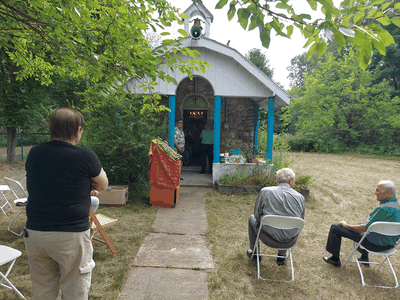
Beneath the old trees of a farm in Elgin, a small white chapel with a stone porch and four turquoise columns sent Byzantine chant across a sunlit lawn, carried by a loudspeaker set in its tiny belfry. Worshippers seated on folding chairs followed the divine liturgy through the open doors as an icon draped in red and gold brocade and crowned with flowers waited at the head of the stone path. The service marked the return of worship to a sanctuary that had stood silent for years, and it drew together a promise kept to a departed Cretan couple, a caretaker of Armenian heritage who has watched over their chapel ever since, and families intent on handing faith, language and custom to the generations that follow.
The Chapel of Saint Paraskevi, known to Greek speakers as Agia Paraskevi, stands at 2458 chemin de la 1re Concession, near Huntingdon and close to the border with New York State. Evangelia and Dimitrios Saridakis built it on their farm, and the inscription above its entrance dates it to 1995. The couple are buried on the grounds. The liturgy celebrated on July 26, the feast day of the saint, was the first held there since their deaths roughly eight years ago.
The revival began with Pavlos Flikas, whose native village in Greece also honours the saint with a church of its own. For seven years, he said, the obstacle had been finding a priest to serve the chapel. He raised the matter with Laval city councillor Aglaia Revelakis, who keeps a country home in the area. “I told her, ‘Aglaia, I have a problem. We cannot open Saint Paraskevi,'” Flikas recalled. “She told me, ‘Tomorrow we will find a priest.’ And her dream came true, and of course mine, because I wanted very much for us to open the church and worship as everyone has now come to do.”
Revelakis said the gathering came together in a single week. The first priest she called was bound to memorial services that Sunday, and within minutes Father Antonios telephoned to say he would come. He had consecrated the chapel at its founding. “When I brought him here, he was stunned,” Flikas said. “He told me, ‘I opened this church.'”
Inside, icons cover nearly every wall beneath a brass chandelier ringed with candles. Father Antonios, in white vestments embroidered in blue, raised his arms before an iconostasis bearing the Virgin and Child and Christ Pantocrator, while chanter Athanasios Zoitakis, who has served at Holy Cross parish for 15 to 20 years, sang the responses from a lectern. “I see God every day,” Zoitakis said. “Sleep is death, and when I rise in the morning, it is a resurrection.”
Tradition holds that Saint Paraskevi was born in Rome in the second century to devout Christian parents and named for Friday, the day of the Crucifixion. Arrested under the Emperor Antoninus Pius, she was cast into a cauldron of boiling oil and pitch and emerged unharmed, and when the emperor was blinded leaning over the vessel, her prayers restored his sight. The church venerates her as protector of the eyes. “Let us call upon Saint Paraskevi to save us and to open not only the eyes of our body but the eyes of our soul, so that we may see the truth and walk the road of salvation,” Father Antonios said after the service.
The chapel’s survival owes much to a caretaker known to worshippers as Jack, who is of Armenian heritage and who promised Evangelia Saridakis that he would keep it open each year. “They were very, very good people,” he said of the couple. “Here there is a piece of Greece, of Crete, in Canada.” He spoke of visitors who credit the saint with answered prayers, among them a woman told by doctors she would never have children who is now a mother, and a man whose failing sight was restored.
Longtime visitors recalled the couple’s hospitality. Zoe Batsis, a familiar figure in the community’s Greek schools, said she had come for years while Evangelia was alive. “It was very moving to see her after the liturgy handing out food and welcoming everyone,” she said. “I still get goosebumps.” Evangelia Tsoumpanaki, who knew the family for half a century, was moved to tears. “They were full of philotimo, hospitable, the best,” she said. “Among the finest of Crete.”
In earlier years the feast drew a full panigyri, with buses arriving from Laval and parishes across the region, stalls serving sandwiches and souvlaki, and religious goods from a monastery. Flikas intends to restore that scale next year and plans to invite Abbess Thekla and her monastery to assist. Kostas Milonopoulos, a former president of the Hellenic Community of Laval and Revelakis’s husband, pledged his support. “I told Pavlos that he needs help,” he said. “Every year, if he wishes, I will come here with him to help however I can.” Tina Flikas, who attended with her husband, voiced a broader concern. “Let us not leave our churches to become deserted,” she said. “It would be a shame.”
Continuity across generations ran through every conversation on the lawn. Revelakis urged young people to join their elders at liturgies and feast days as readily as they attend festivals. “When you marry and have children, the first thing you will do is start bringing your children to church so they take the path of God,” she said. “We must teach our children to continue what our parents taught us, because we learned it from our parents,” Milonopoulos said, adding that language, faith and customs must be preserved together. Batsis, born in Canada to an immigrant father, said her children speak beautiful Greek and her grandchildren are working at it. Her granddaughter Marie has begun lessons on her own and writes to her in Greek, and her grandson Christakis applied for and received Greek citizenship. Young Anastasia, among the smallest worshippers, offered her own testimony. “I go to Socrates school,” she said. “I’m learning Greek.”
After the service, Michalis Hatzichristos distributed the antidoron from the artoklasia offered in the saint’s honour. Asked what Saint Paraskevi would tell young people today, he answered simply: “To forgive and to have love.”
A closed bridge on the access route delayed many worshippers, who continued to arrive at the farm well after the liturgy had ended. Revelakis said the chapel would remain open to receive them.
[Back to Headlines] | [Article Archive] | [Home] | [Original Article]